Best Eco Friendly Treehouse Plans: The 2026 Engineering Authority Guide
The modern pursuit of arboreal living has transitioned from a nostalgic architectural trope into a rigorous discipline of sustainable engineering. In 2026, the concept of a “treehouse” is increasingly decoupled from the heavy-timber, high-impact structures of the past. Instead, we are seeing the rise of “Active Biophilic” design—structures that do not merely sit within a forest but function as an extension of the host organism’s metabolic and structural logic.
The complexity of designing at height involves a fundamental conflict: the desire for human permanence versus the biological imperative of tree growth. Traditional construction often views the site as static, but a tree is a fluid foundation, expanding radially and swaying kinetically. To achieve a truly ecological result, one must adopt a “successional” mindset, planning for a structure that adapts over decades rather than resisting the environment through rigid force.
This guide serves as a technical and philosophical pillar for those seeking the best eco-friendly treehouse plans. It moves beyond the surface-level aesthetic of “rustic wood” to examine the underlying physics of Tree Attachment Bolts (TABs), the chemistry of VOC-free finishes, and the systemic requirements of off-grid waste management. By the end of this analysis, the reader will possess a framework for evaluating arboreal architecture through the lenses of structural honesty, biological safety, and long-term climate resilience.
Understanding “best eco-friendly treehouse plans.”
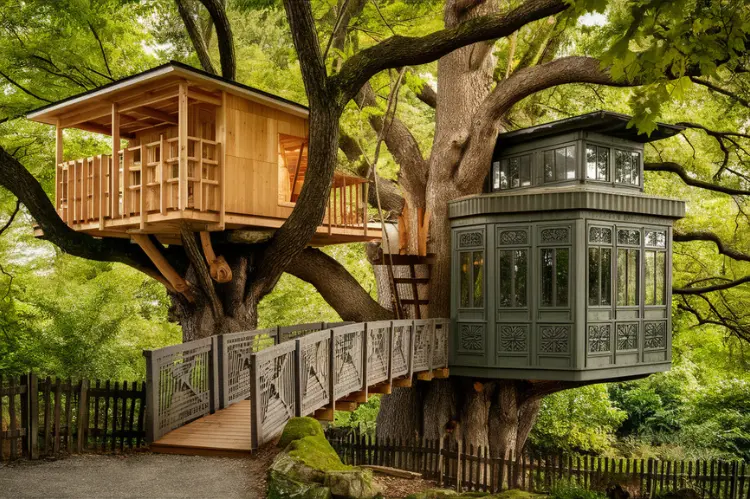
A primary point of failure in the market is the conflation of “Green Aesthetics” with “Eco-Friendly Engineering.” Many plans marketed as sustainable are merely terrestrial cabins placed on stilts, failing to address the “Biological Tax” the structure imposes on the forest. To identify the best eco-friendly treehouse plans, one must look for designs that prioritize the host tree’s “Vascular Health” over the inhabitant’s square footage.
The most common misunderstanding involves the method of attachment. A truly eco-friendly plan avoids “Girdling”—the practice of wrapping cables or chains around a trunk, which eventually chokes the tree’s phloem and kills it. Instead, superior plans utilize specialized hardware like Tree Attachment Bolts (TABs). These high-strength steel alloy bolts are designed to mimic a branch; the tree grows around the bolt, compartmentalizing the wound and incorporating the hardware into its heartwood, effectively making the structure part of the tree’s own skeletal system.
Furthermore, oversimplification risks occur when “Eco-Friendly” is reduced to “Material Sourcing.” While using reclaimed cedar is admirable, if the plan requires the clearing of a significant understory or utilizes a foundation that compacts the “Fine-Root Zone,” the net environmental impact remains negative. The best plans are “Site-Specific,” meaning they account for the specific species of the host—recognizing that the lateral load capacity of a White Oak differs fundamentally from that of a Douglas Fir.
The Systemic Evolution of Arboreal Engineering
Historically, treehouses were either primitive survival platforms or whimsical play-spaces. The “Arboreal Pivot” of the early 21st century introduced structural engineering to the canopy, but often at the cost of the tree’s longevity. We are now in the “Regenerative Era,” where the goal is a “Net-Positive” relationship with the forest.
In 2026, the evolution is marked by “Root-Agnostic Foundations.” Modern plans often eschew traditional concrete piers in favor of helical piles—steel screws that twist into the earth between the roots rather than cutting through them. This preservation of the “Mycorrhizal Network” (the fungal communication system between trees) is now a standard requirement for any design claiming true sustainability.
Conceptual Frameworks: The Dimensions of Vertical Sustainability
To evaluate a plan’s long-term viability, we utilize three primary mental models:
1. The “Radial Expansion” Protocol
Trees grow outward, not just upward. A plan that does not include “Growth Gaps”—adjustable spacers between the deck and the trunk—will eventually be crushed by the tree itself. This framework ensures the structure remains “Floating,” allowing the tree to thicken without structural interference.
2. The “Kinetic Damping” Quotient
Unlike ground-based buildings, treehouses are in motion. A high-quality plan manages the “Differential Sway” between two or more trees. Using universal joints and sliding brackets, the floor remains level while the trees move independently. Without this, the structure acts as a “Torque Bar,” potentially snapping the limbs of the host trees during high-wind events.
3. The “Closed-Loop Metabolism” Model
This framework treats the treehouse as a biological organism. It assesses how water, waste, and energy flow through the site. A “Net-Zero” plan incorporates “Gravity-Fed Greywater” filtration, where water used in a sink is filtered through a vertical planter to nourish the tree’s roots, rather than being piped away to a septic system.
Key Categories of Eco-Friendly Treehouse Plans
The best eco-friendly treehouse plans generally fall into one of six structural categories, each offering distinct trade-offs in terms of impact and luxury.
Decision Logic for Plan Selection
When choosing a category, the “Soil Shear Strength” of the site is the deciding factor. If the ground is prone to erosion, a TAB-Supported Pod is superior because it removes the load from the sensitive soil. Conversely, in a forest with young, fast-growing trees, a Helical Pier Hybrid is safer, as it provides a permanent foundation that doesn’t rely solely on the immature trunk’s strength.
Detailed Real-World Scenarios and Failure Modes
The Pacific Northwest Rain Forest
-
Context: High humidity, old-growth conifers, high wind loads.
-
Optimal Plan: A heavy-duty TAB system with a breathable “Living Roof” to manage moisture.
-
Failure Mode: “Acoustic Resonance.” If the roof is metal, the sound of heavy rain can reach 80dB, causing significant stress to the inhabitants.
-
Second-Order Effect: The weight of the wet living roof might exceed the “Dynamic Load” limit during a storm, requiring a reduction in interior furniture.
The Semi-Arid Scrubland
-
Context: Low water availability, brittle hardwood trees (e.g., Live Oak).
-
Optimal Plan: A “Reciprocal Frame” that sits low in the canopy to avoid wind-shear.
-
Failure Mode: “Embodiment Heat.” Large windows without “Thermal Breaks” can turn the treehouse into a greenhouse, requiring energy-intensive cooling that negates the eco-friendly intent.
Planning, Cost, and Resource Dynamics
The economics of arboreal construction include a “Complexity Premium.” Moving materials to a height of 20 feet without heavy machinery increases labor hours by approximately 40% compared to terrestrial builds.
The “Opportunity Cost” of Height: Every foot of elevation increases the “Logistical Friction” of maintenance. A treehouse at 30 feet requires professional climbing gear for every gutter cleaning, a cost that must be factored into the 10-year lifecycle of the plan.
Risk Landscape and Compounding Failure Modes
The primary risks in eco-friendly treehouse construction are not singular events but “Compounding Failures.”
-
Arboreal Senescence: The host tree dies of natural causes. If the plan doesn’t include a “Redundancy Support” (like a hidden stilt), the structure becomes a total loss.
-
Vascular Strangle: If the owner fails to adjust the “Growth Gaps” annually, the tree will eventually grow into the floor joists, causing localized rot and structural instability.
-
Soil Compaction: Frequent foot traffic around the base of the tree crushes the air pockets in the soil, suffocating the roots and leading to “Crown Dieback,” which makes the tree more prone to falling in a storm.
Governance, Maintenance, and Long-Term Adaptation
The best eco-friendly treehouse plans are accompanied by a “Biological Governance” manual. This isn’t a static document but a living schedule for monitoring the symbiosis between the building and the tree.
The Layered Maintenance Checklist:
-
Bi-Annual: Torque-check all TABs to ensure the tree hasn’t pushed them out.
-
Annual: Inspect “Bark Inclusion” areas where the structure meets the tree for signs of fungal infection or pest entry.
-
5-Year Cycle: Professional arborist “Crown Thinning” to reduce the wind-load on the structure-heavy limbs.
-
Event-Driven: Post-storm inspection for “Hairline Stress Fractures” in the support brackets.
Measurement, Tracking, and Evaluation
How do we prove a treehouse is actually “Eco-Friendly”? We track three “Biological Indicators”:
-
Sap Flow Monitoring: Using ultrasonic sensors to ensure the host tree’s water transport hasn’t slowed down since construction.
-
Carbon Sequestration Offset: Calculating the embodied carbon of the building materials against the carbon sequestered by the host tree over its lifespan.
-
Biodiversity Delta: Monitoring the number of bird and insect species in the canopy before and after the build. A “Net-Positive” design often increases biodiversity by providing new nesting sites in the structure’s eaves.
Common Misconceptions and Oversimplifications
-
Myth: “Nails are better than bolts because they are smaller.”
-
Correction: Hundreds of small nails cause “Diffuse Trauma,” making it harder for the tree to heal. One large TAB is a “Clean Wound” that the tree can easily seal.
-
-
Myth: “Any wood is eco-friendly because it’s natural.”
-
Correction: Pressure-treated wood contains copper and arsenic, which can leach into the tree’s vascular system. Only “Thermally Modified” or naturally rot-resistant woods like Cedar or Black Locust should be used.
-
-
Myth: “The tree will carry anything.”
-
Correction: Trees have a “Dead Load” limit. Exceeding it causes the tree to allocate all its energy to structural reinforcement (reaction wood) rather than growth or defense against pests.
-
Ethical, Practical, and Contextual Considerations
Building in the canopy is an act of “Inter-Species Cooperation.” It carries the ethical responsibility of potentially shortening the life of a sentinel organism. Therefore, the “Best” plan is often the smallest one. The “Micro-Dwelling” philosophy—prioritizing high-quality, high-tech biophilic materials over square footage—is the most ethical path forward in 2026.
Practicality also dictates that “Fire Mitigation” is a primary concern. Eco-friendly treehouses in fire-prone zones must utilize “Non-Combustible” organic materials like Magnesium Oxide boards rather than traditional timber siding, ensuring that the human dwelling doesn’t become a torch for the rest of the forest.
Conclusion: The Synthesis of Protection and Adventure
The search for the best eco-friendly treehouse plans is ultimately a search for a more honest way to inhabit the earth. It requires a departure from the “Conquest” mindset of traditional architecture and an embrace of “Adaptability.” A successful arboreal structure moves with the wind, grows with the seasons, and eventually leaves no trace upon its removal.
By focusing on “Structural Transparency”—where every bolt and beam serves both the human and the tree—we can create spaces that are not just retreats from the world, but deeper entries into it. The authority of a treehouse is not found in its height, but in the health of the tree that holds it.